
Learning Disentangled Features for NeRF-Based Face Reconstruction
HeadNeRF+ reconstruction with disentangled facial representations
IEEE International Conference on Image Processing, 2023
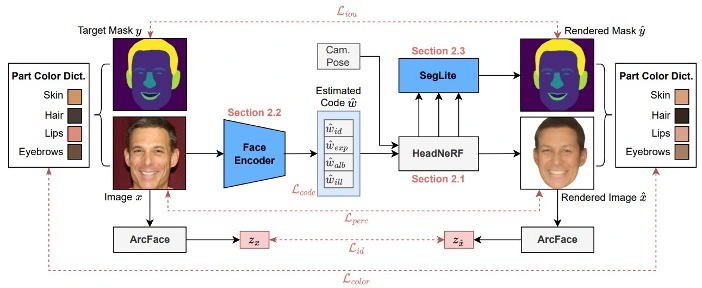
HeadNeRF+ method overview supplied by the project author.
I. Overview
HeadNeRF can render photorealistic, controllable faces, but fitting its latent codes to each image is slow and prone to overfitting. HeadNeRF+ replaces iterative fitting with a learned encoder that directly predicts the disentangled reconstruction features.
The framework also introduces explicit semantic face-part guidance even though the underlying NeRF does not expose a conventional mesh.
II. Key Contributions
- Predicts HeadNeRF’s disentangled identity, expression, and appearance features directly from an input image.
- Adds a lightweight semantic face-segmentation network to expose facial-part structure.
- Uses a facial-part loss to improve reconstruction accuracy and local visual quality.
III. Methodology
A face encoder estimates the latent parameters consumed by a pretrained HeadNeRF renderer. A lightweight segmentation branch supplies semantic facial regions, and part-aware losses guide the encoder toward more accurate local reconstruction.
IV. Main Findings
The experiments report much lower reconstruction time than per-image fitting together with improved reconstruction accuracy and visual quality.
Reference
Citation
BibTeX citation
@inproceedings{yan2023learning,
  title={Learning disentangled features for NERF-based face reconstruction},
  author={Yan, Peizhi and Ward, Rabab and Wang, Dan and Tang, Qiang and Du, Shan},
  booktitle={2023 IEEE International Conference on Image Processing (ICIP)},
  pages={1135--1139},
  year={2023},
  organization={IEEE}
}
Continue exploring
Related Projects
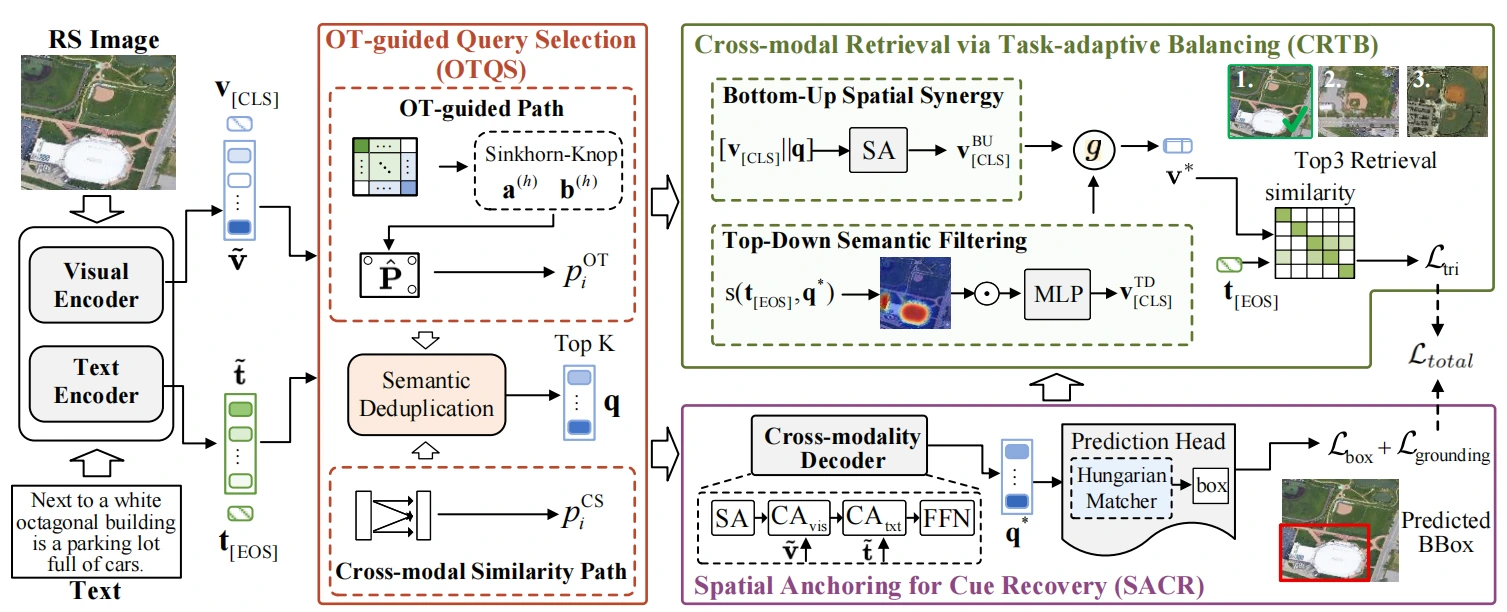
Explicit Spatial Localization and Task-Adaptive Balancing for Remote Sensing Image-Text Retrieval
A remote-sensing image–text retrieval framework that combines explicit object localization with adaptive coordination between spatial and semantic learning objectives.
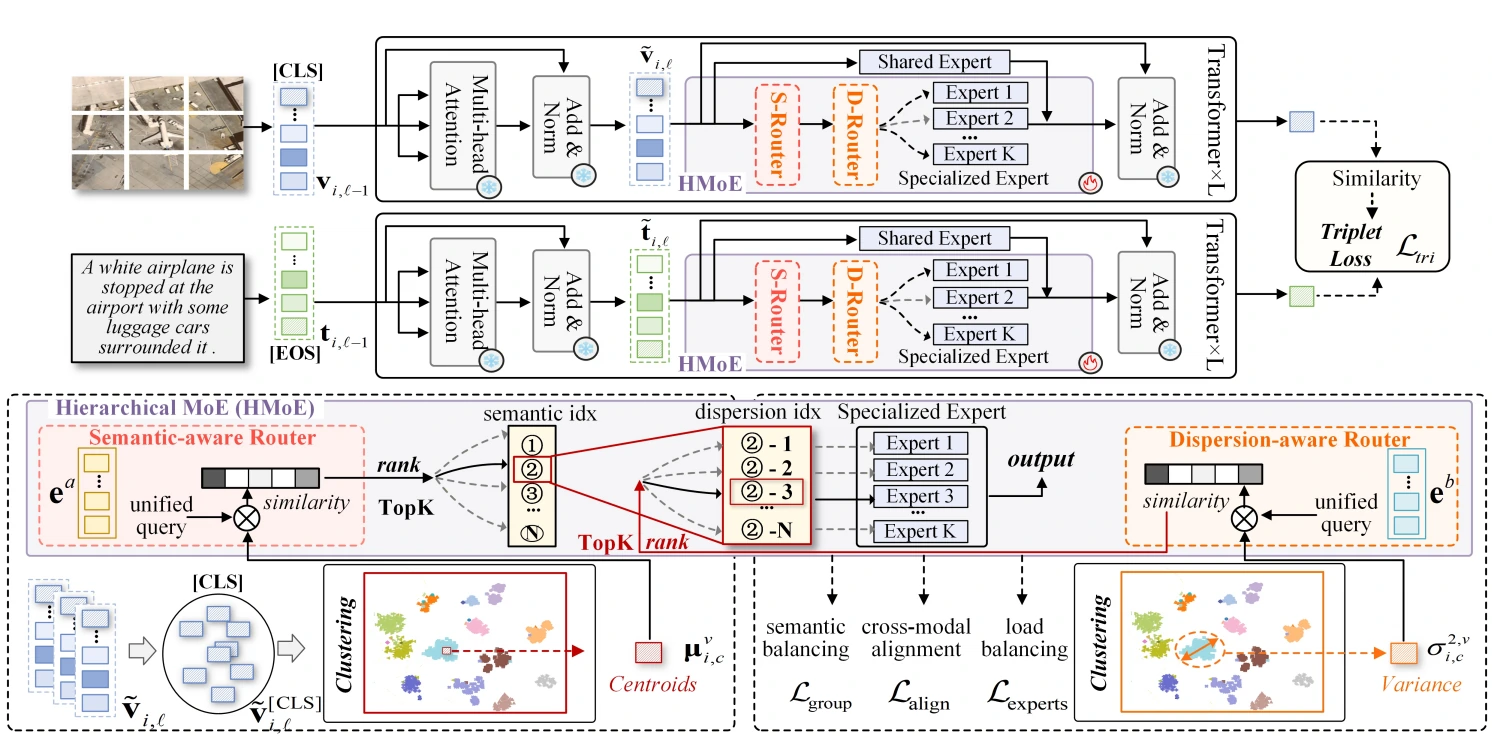
H-MoC: Hierarchical Mixture-of-Experts for Semantic- and Dispersion-Consistency in Remote Sensing Image-Text Retrieval
A hierarchical mixture-of-experts retrieval framework that promotes both semantic consistency and balanced feature dispersion across remote-sensing image and text representations.