
Neural 3D Face Shape Stylization Based on Single Style Template via Weakly Supervised Learning
Fast 3D face stylization from one artist-created template
IEEE Transactions on Visualization and Computer Graphics, 2025
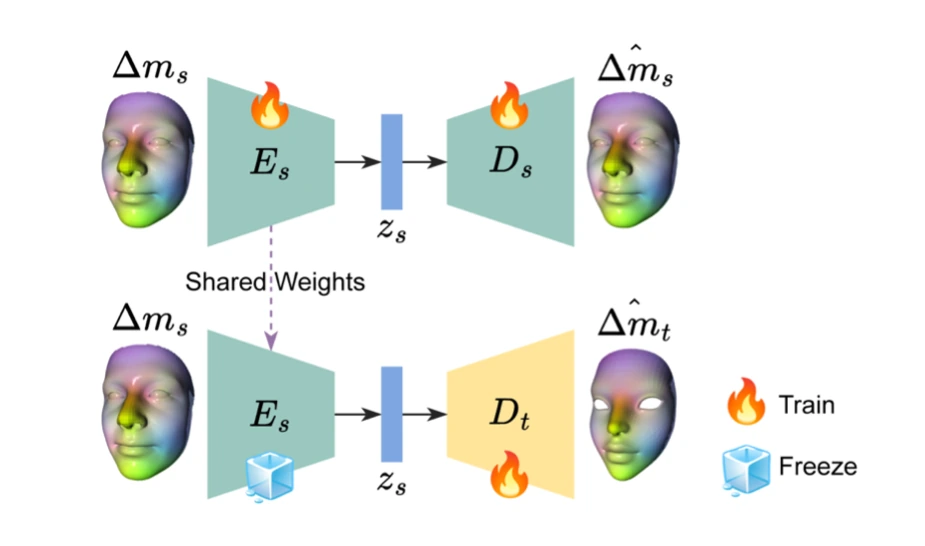
Neural 3D face stylization method overview supplied by the project author.
I. Overview
Traditional deformation transfer can preserve a person’s facial characteristics in a stylized template, but it is slow and must be optimized again for every new face. This work learns the transfer once and applies it directly to new inputs.
Only one style template is needed for each target look, reducing artist effort and avoiding paired realistic-to-stylized training meshes.
II. Key Contributions
- Frames 3D face shape stylization as a fast learned deformation-transfer problem.
- Uses weak supervision so paired source and stylized training data are not required.
- Introduces template-guided mesh smoothing to preserve the intended structure of each style.
III. Methodology
A neural network predicts the deformation from a realistic input face to a chosen style template. Training uses weak supervision and a template-guided mesh-smoothing regularizer that discourages structural artifacts while retaining identity-related facial shape.
IV. Main Findings
The paper reports stylization quality comparable to conventional deformation transfer at roughly 3,000 times the processing speed, with an average Chamfer distance of about 0.01 mm.
Reference
Citation
BibTeX citation
@Article{Yan_2025_FaceStylization,
  author  = {Yan, Peizhi and Ward, Rabab K. and Tang, Qiang and Du, Shan},
  title   = {Neural 3D Face Shape Stylization Based on Single Style Template via Weakly Supervised Learning},
  journal = {IEEE Transactions on Visualization and Computer Graphics},
  year    = {2025},
  volume  = {31},
  number  = {10},
  pages   = {9522--9529},
  doi     = {10.1109/TVCG.2025.3573690}
}
Continue exploring
Related Projects
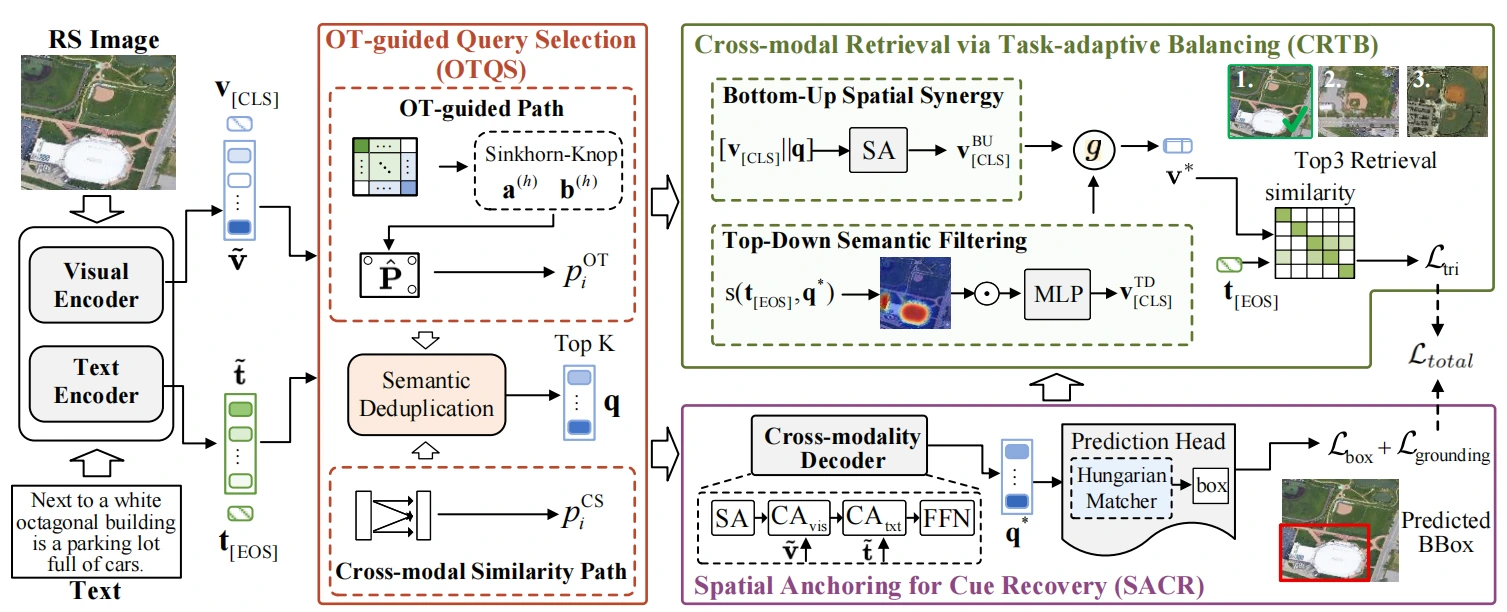
Explicit Spatial Localization and Task-Adaptive Balancing for Remote Sensing Image-Text Retrieval
A remote-sensing image–text retrieval framework that combines explicit object localization with adaptive coordination between spatial and semantic learning objectives.
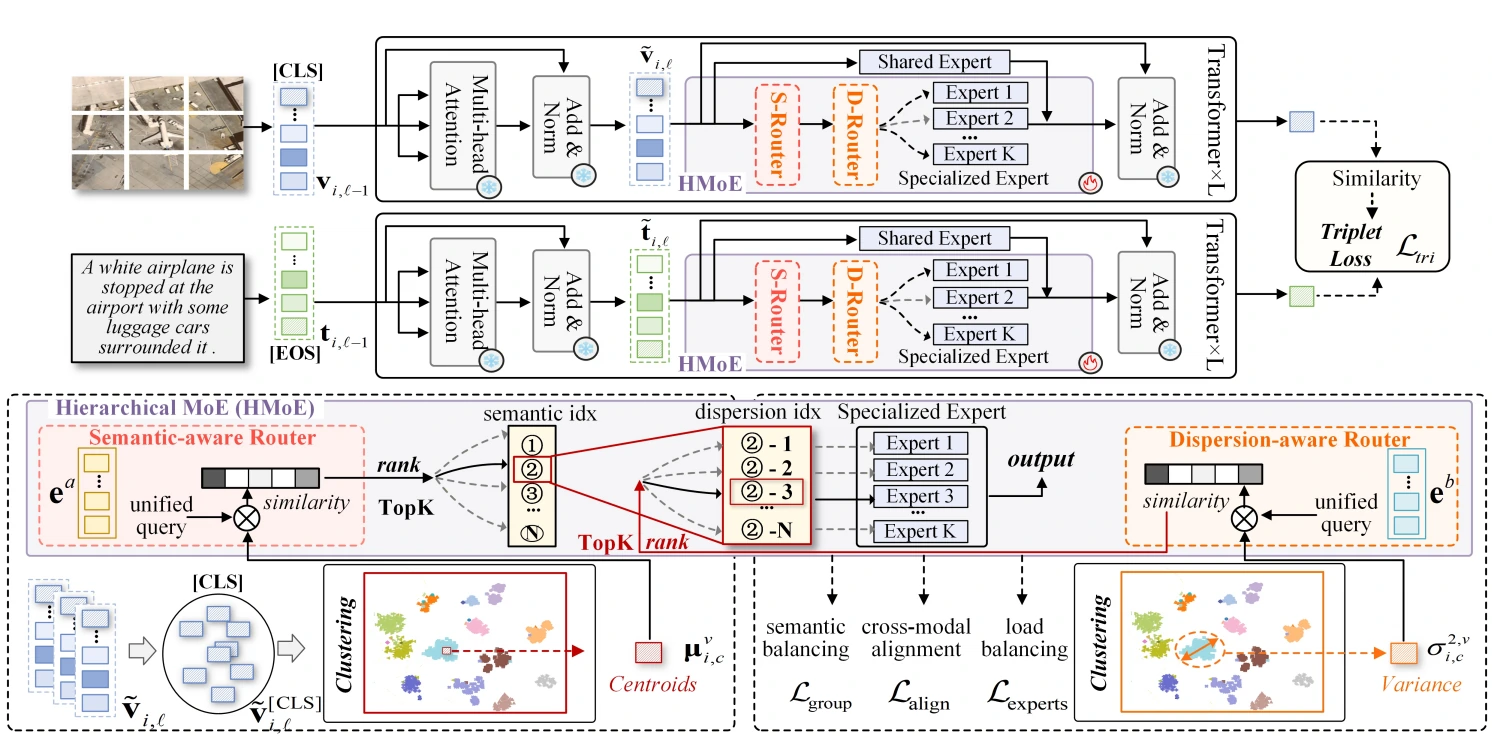
H-MoC: Hierarchical Mixture-of-Experts for Semantic- and Dispersion-Consistency in Remote Sensing Image-Text Retrieval
A hierarchical mixture-of-experts retrieval framework that promotes both semantic consistency and balanced feature dispersion across remote-sensing image and text representations.